Table of Contents
You’ve found a supplier on Alibaba with great product photos, fast replies, and prices that look almost too reasonable. Then you spot another one with a proper factory tour video, ISO certificates, and a noticeably higher quote. Both call themselves LED display manufacturers. One of them is not.
This is the situation procurement managers, AV integrators, and DOOH operators run into more often than they should. The difference between a direct LED display manufacturer and a trading company is not just a matter of price. It affects lead times, engineering support, spare parts availability, and long-term project stability. Getting it wrong on a bulk order costs you far more than the markup you were trying to avoid in the first place.
Key Takeaways
|
What Is the Difference Between an LED Display Manufacturer and a Trading Company?
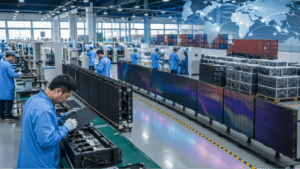
A direct LED display manufacturer and system integrator controls the critical stages of the production chain. In-house cabinet assembly, custom structural engineering, system configuration, and 72-hour full-screen aging testing all sit under one roof. When you ask a technical question, you reach an engineer who actually built the system.
A trading company is a commercial sales agency. They source finished screens from third-party LED display screen manufacturers, add their margin, and resell. They work well for small, mixed orders, but they do not control what they are selling you.
| Feature | Direct LED Display Manufacturer/Integrator (e.g., Dreamway LED) | Trading Company |
| Pricing | Direct factory pricing, no middleman markup | 15%–40% added margin |
| Manufacturing | In-house cabinet assembly, system integration, and 72-hour aging test | None (third-party factories) |
| Customization | Custom structural CAD design, pixel pitch engineering, custom cabinet configurations | Basic branding/packaging only |
| Spare Parts | Exact batch-matched modules, power supplies, receiving cards | Dependent on supplier stock |
| MOQ | Medium to high (project-based) | Flexible, very low MOQ |
| Technical Support | Direct engineer access | Relayed through sales reps |
The wider market context is worth keeping in mind. The global LED display screen market was valued at $14.8 billion in 2025 and is projected to reach $34.6 billion by 2034, at a CAGR of 9.9%. With that level of growth comes an equally fast-growing number of resellers positioning themselves as factories. The distinction has never mattered more.
The Pros and Cons of Buying Direct from a Chinese LED Display Manufacturer
- Significant cost savings on bulk orders. Trading companies add 15% to 40% over factory production costs. On a project involving hundreds of square meters of outdoor video wall, that markup becomes a real budget line that buys you nothing extra.
- Advanced customization. A real OEM LED screen supplier designs to your spec, not just picks from a catalog. That includes:
- Flexible LED panels for curved architectural integration
- Fine-pitch indoor walls for broadcast studios and control rooms
- Transparent display formats for retail window installations
- Custom steel cabinet structures with engineered mounting systems
Unlike rigid component manufacturers or markup-heavy trading companies, a custom LED display manufacturer and integrator like Dreamway selects top-tier LED modules from specialist suppliers. The modules are paired with premium power units such as Mean Well and control systems such as Novastar. Rigorous 72-hour batch aging tests are done before shipping. The result is a complete, calibrated video wall system built to your exact project requirements.
Dreamway LED produces full CAD structural drawings for custom cabinet configurations. A trading company cannot offer that because they do not own the fabrication process.
- Quality assurance with full traceability. A direct factory runs a 72-hour aging test before anything ships. Screens cycle continuously through red, green, blue, and full-white stress tests to catch dead pixels, driver IC failures, and power supply defects before they leave the building, not when you are installing them on-site at 11pm.
- Spare parts that actually match. LED bead binning matters more than most buyers realise. Modules from the same batch share the same color wavelength characteristics. A direct factory provides 3% or more spare modules, power supplies, and receiving cards from the exact production batch. A trading company may send you replacements that look close but are technically inconsistent, and months later you will have visible color banding across your wall.
Where It Gets More Demanding
Higher MOQs than trading companies. Direct factories are built for project-scale orders, not single-unit purchases.
Communication requires precise technical briefs. Factory engineers are not generalist sales reps. They execute against detailed specifications, so you need to arrive at the conversation knowing what you need.
How to Tell If an LED Supplier Is a Real Manufacturer or a Trading Company
This is where most buyers get caught, because in 2026 the surface presentation of both is nearly identical. Good photography, polished websites, and an Alibaba Gold Supplier badge do not tell you whether you are speaking to a LED display screen manufacturer in China or a reseller with a catalog and a WhatsApp.
Step 1: Inspect the Chinese Business License
Request the actual document and look at the Business Scope. A genuine B2B LED display supplier will list assembly, integration, and sales of optoelectronic or LED display products. A trading company’s scope will reference wholesale, import/export trade, and sales. This is the fastest verification you can do, and most buyers never think to ask for it.
Step 2: Request an Unannounced Live Video Audit
Ask for a five-minute video call and request to see three specific zones: the cabinet assembly and precision wiring area, the system calibration and control card testing zone, and the 72-hour full-screen aging and burn-in test room with screens actively under load.
If the response is that the workshop has poor Wi-Fi, or that a video audit needs to be scheduled weeks in advance for confidentiality reasons, you are not speaking to a factory.
Step 3: Check the Physical Address Against Satellite Maps
A genuine LED video wall factory occupies industrial park space, not a downtown commercial office tower. Search the registered address on Google Maps or Baidu Maps and check whether it resolves to an industrial zone (Guangming District in Shenzhen is a common example) or a city-center high-rise.
Step 4: Run a Technical Stress Test in the First Conversation
Ask specific engineering questions. What is the refresh rate of the driver IC, and does it support 3840Hz? What is the PCB copper thickness? How is thermal dissipation managed in the outdoor cabinet at 45°C ambient?
Real factory representatives answer straight away. Trading company reps pause, excuse themselves, and come back with a forwarded response from their actual supplier. You will feel the difference in real time.
What Questions to Ask Before Selecting an LED Display Supplier
Before committing to a bulk order from any B2B LED display supplier, work through this checklist:
- Burn-in protocol: How long is the aging test? A credible answer is 48 to 72 hours minimum.
- Cabinet fabrication: Do you assemble and integrate the cabinets in-house or outsource that process?
- Spare parts: What percentage of free spares come with a bulk order? Target 3% extra modules, receiving cards, and power units from the same production batch.
- Certifications: What certifications are issued directly under your company name? Look for CE, CB, FCC, RoHS, and ISO9001, and verify the registered name on the certificate matches your supplier.
- Warranty coverage: What is the policy on dead pixels and power supply failure, and how long does replacement parts fulfillment take?
Manufacturer vs Trading Company: Which Should You Choose?
The right answer depends on what you are actually buying.
Choose a Trading Company If:
- Your order is one to two test units for evaluation purposes.
- You need very low MOQ with no project-scale commitment.
- You are consolidating mixed categories (LED screens, stage lighting, trussing) through a single commercial agent.
Choose a Direct LED Display Manufacturer (e.g., Dreamway LED) If:
- You are procuring bulk square meters for outdoor billboards, stadium perimeter screens, or a rental LED display screen fleet.
- Your project requires customized hardware: flexible pitch, curved cabinet integration, ultra-bright 7500-nit outdoor panels, or fine-pitch indoor configurations.
- You need direct factory pricing across multiple reorders with consistent spare parts matching from batch to batch.
LED billboards are projected to account for 41.2% of the global outdoor LED display market share by 2026, and that segment is almost entirely built on direct factory relationships. Those projects cannot afford the communication delay, margin overhead, and batch inconsistency that come with a trading company in the middle.
Frequently Asked Questions
What is the difference between an LED display manufacturer and a trading company?
An LED display manufacturer and system integrator handles cabinet assembly, system configuration, custom structural engineering, and full aging testing in-house, which means you get direct factory pricing and engineers who can actually customize the hardware. A trading company sits in the middle, buying from third-party factories and reselling with a 15% to 40% profit margin added on top.
Is it cheaper to buy LED displays directly from a manufacturer in China?
On bulk orders, yes, typically 15% to 40% cheaper because you are cutting out the middleman commission entirely. You also get factory-gate pricing, free spare parts from the same production batch, and direct access to CAD engineering support, none of which a trading company can offer.
What is the average price markup of an LED screen trading company?
Somewhere between 15% and 40% over factory production cost, covering their sales overhead, export handling, and margin. On a large video wall project, that difference can run into thousands of dollars for a product that is functionally identical to what you could have bought directly.
What are the main disadvantages of buying LED screens from a trading company?
Higher per-unit cost is the obvious one, but the less visible problems are often worse: no direct engineering support, no ability to customize cabinet structures or system configurations, and a real risk of inconsistent LED batch binning.
When should a business choose a trading company over an LED manufacturer?
When your order is very small, one to two units for testing or evaluation. Trading companies also make sense if you need an unusually low MOQ, or if you are consolidating mixed product categories like LED screens, stage lighting, and trussing into a single shipment from one agent. Outside those scenarios, the tradeoffs rarely justify the extra cost.
How many hours of aging test should an LED display undergo before shipping?
A reputable manufacturer and integrator like Dreamway LED runs a minimum of 48 to 72 continuous hours of burn-in testing before anything ships. That covers red, green, blue, and full-white screen stress cycles, designed to surface dead pixels, driver IC failures, and power supply defects while the screen is still on the factory floor rather than on your job site.
What spare parts should I request when buying an LED video wall in bulk?
At minimum, ask for 3% to 5% extra spare modules, 3% receiving cards, 3% power supplies, IC chips, and matching data and power cables, all from the exact same production batch. The batch matching is the part most buyers forget to specify, and it is what keeps color uniformity consistent when you need to swap something out a year later.
What certifications should an LED screen manufacturer hold for global export?
CE, EMC, and RoHS for European markets. FCC and ETL/UL for North America. ISO9001 for factory quality management. The critical detail is that the company name on the certificate must match the supplier you are dealing with, not a third-party agent or a parent company you have never spoken to.