Table of Contents
| Key Takeaways:
|
Modern events use LED screens as essential visual engines that engage audiences through live camera feeds, custom visuals, and high-resolution displays. When a client is looking for a stage rental LED screen, they want to make sure that their audience experience is not compromised by poor image quality, camera flicker, or setup delays.
So, for LED rental companies, buying these displays is a calculated investment. It requires more than easy transportation, assembly, and dismantling. LED displays are used in a wide range of events, each having unique requirements. Therefore, it is important to understand how technical specifications, cabinet design, pixel pitch, and refresh rate dictate performance in a venue. This guide explains the technical specifications rental companies should evaluate before investing in a new LED screen fleet.
What Cabinet Size Is Best for a Rental LED Screen Fleet?
The following are the most commonly used cabinet dimensions:
- 500 × 500 mm
- 500 × 1000 mm
With their modular design, you can easily assemble them into different configurations, screen sizes, and aspect ratios.
| Specification | 500 × 500 mm | 500 × 1000 mm |
| Cabinet area | 0.25 m² | 0.50 m² |
| Weight | Approx. 7 kg | Approx. 13 kg |
| Best suited for | Flexible layouts, smaller sections | Large stage backdrops |
| Cabinets for a 6 × 3 m wall | 72 | 36 |
| Main advantage | Configuration flexibility | Fewer connections |
If your rental company handles different stage rental LED screen sizes, 500 × 500 mm cabinets provide you with the flexibility to create smaller sections or complex layouts. You can invest in Dreamway’s 500 Series rental LED cabinets, which also support curved configurations and hanging or stacking installations.
500 × 1000 mm cabinets reduce the number of cabinets required for a large rental LED screen size.
Which Pixel Pitch Should You Choose for Indoor and Outdoor Events?
Pixel pitch is the distance between the centers of two adjacent LED pixels. It is measured in millimeters. A cabinet with a smaller pixel pitch has higher pixel density. As a result, the LED display produces a sharper, more detailed image, especially when the audience is close to the LED screen.
On the other hand, displays with higher pixel pitch have lower pixel density. These displays are suitable for longer viewing distances where extreme detail is less critical. Higher pixel pitch rental displays are more cost-effective.
| Pixel Pitch | Approx. pixels/m2 | Applications |
| P1.953 | 262,000 | Close-viewing indoor presentations |
| P2.604 | 147,000 | Conferences and indoor stages |
| P2.976 | 113,000 | Corporate events and concerts |
| P3.91 | 65,000 | Larger stages and mixed events |
| P4.81 | 43,000 | Outdoor stages with distant audiences |
Indoor rental LED screens used at events such as conferences or exhibitions must deliver the necessary detail for audiences positioned close to the stage. Opt for P1.953 or P2.604.
Outdoor events typically require a large rental LED screen as spectators view the display from greater distances. P3.91 or P4.81 outdoor rental LED screens are ideal for such events.
Ingress Protection (IP) Rating
Weather protection is important for outdoor LED displays. Make sure you check the IP rating of the LED display. An Ingress Protection (IP) rating consists of two digits (e.g., IP65). The first digit measures protection against solid objects and dust. The second digit measures protection against liquids.
First Digit
| Digit | Protection Level | Effective Against |
| 0 | No protection | None |
| 1 | Large objects | Objects > 50 mm |
| 2 | Medium objects | Objects > 12.5 mm |
| 3 | Small objects | Objects > 2.5 mm |
| 4 | Granular objects | Objects > 1 mm |
| 5 | Dust-protected | Limited dust entry; non-harmful amount |
| 6 | Dust-tight | Complete sealing; no dust ingress |
Second Digit
| Digit | Protection Level |
| 0 | No protection |
| 1 | Vertical dripping |
| 2 | Dripping (tilted 15°) |
| 3 | Spraying water (up to 60° from vertical) |
| 4 | Splashing water (from any direction) |
| 5 | Water jets (Low-pressure water jets from any angle; 6.3 mm nozzle) |
| 6 | Powerful jets (High-pressure water jets; 12.5 mm nozzle) |
| 7 | Temporary submersion (up to 1 m depth; typically 30 min) |
| 8 | Continuous submersion (deeper than 1 m) |
| 9K | High-pressure/temp jets |
Brightness is equally important. For rental LED for indoor events, the brightness should be approximately 800–1,200 nits, and for outdoor LED displays, it should be 4,000–5,000 nits.
When investing in an LED rental display fleet, rental companies should compare:
- Pixel pitch
- Screen resolution
- Audience distance
- Brightness
- Operating conditions
What Makes a Rental LED Cabinet Durable Enough for Repeated Setup?
Rental LED screens are assembled, dismantled, and transported between events. They must withstand repeated handling. Choose cabinets with the following features:
- Die-cast aluminum cabinet
- Quick-lock mechanisms
- Corner protection
- Front and rear maintenance access
Invest in high-quality power and signal connectors. Damaged or loose connectors can interrupt electricity or video signals, causing sections of the display to malfunction. Make sure that the cabinets are compatible with protective flight cases.
What Refresh Rate Does a Rental LED Screen Need for Cameras and Live Events?
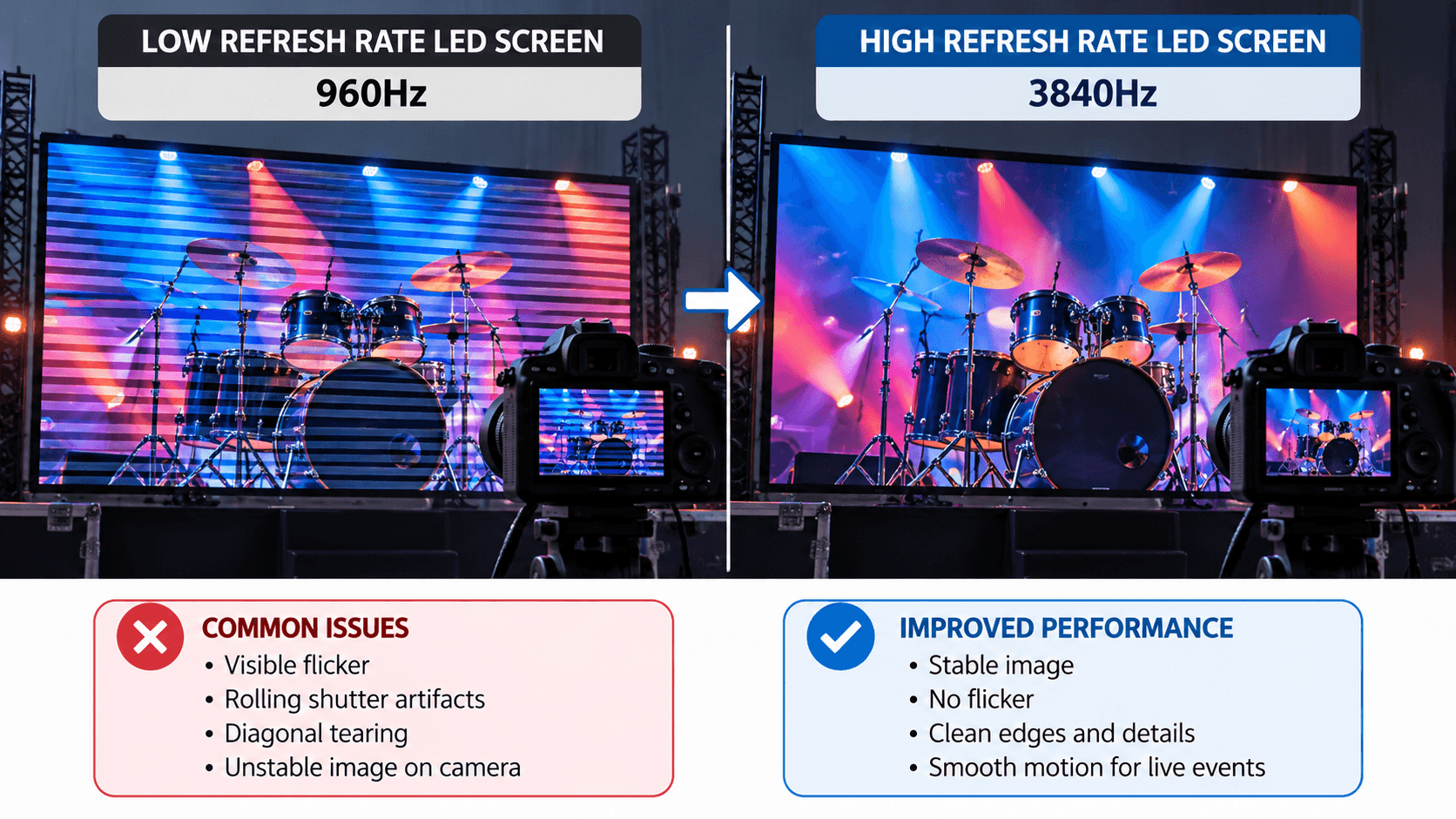
Refresh rate is the number of times per second a display updates the image on the screen. It is measured in Hertz (Hz). A higher rental LED screen refresh rate can help reduce visible scan lines and flicker when displays are recorded by cameras.
| Refresh Rate | Consideration |
| 1,920 Hz |
|
| 3,840 Hz |
|
| 7,680 Hz |
|
When it comes to live camera feeds, many rental companies commonly consider high-refresh-rate LED screens (such as 3,840 Hz models) to reduce the risk of visible flicker and horizontal bands in recorded footage. However, the refresh rate alone does not determine camera performance. The LED driving technology, scanning method, and camera shutter settings also affect the results.
Opt for a 7,680 Hz CF500 Series rental LED display for demanding filming applications.
How Many Spare Parts Should Rental Companies Order?
A rental company should keep the following spare parts so that their technicians can quickly replace faulty components:
- LED modules
- Power supplies
- Receiving cards
- Power and signal cables
- Cabinet locks and connectors
The number of spare parts you must keep depends on the size of your rental fleet, the number of events you run simultaneously, and how quickly you can get the replacement components. Your stage LED screen supplier can provide a better idea. Also verify approved hanging loads, stacking arrangements, and rigging hardware.
Shenzhen Dreamway Technology is China’s trusted custom Rental LED screen manufacturer and supplier, delivering the latest indoor and outdoor LED display technology at competitive wholesale prices.
| Planning your next stage event fleet? Contact Dreamway’s technical experts today for a customized wholesale quote. |
Frequently Asked Questions
What is the best cabinet size for a rental LED screen?
A 500 × 500 mm cabinet offers flexibility for varying stage layouts. A 500 × 1000 mm cabinet reduces cabinet counts for large displays.
Which pixel pitch is best for indoor concerts?
P2.604 and P2.976 are practical starting points for an indoor concert stage LED screen. P1.953 may be suitable for closer viewing. Choose P3.91 for larger venues.
Can the same rental LED screen be used indoors and outdoors?
If the configuration meets the requirements of both environments, then you can use the same screen indoors and outdoors. Make sure you check the IP rating.
Is a 3,840 Hz refresh rate sufficient for live streaming?
A 3,840 Hz display can perform well in live productions. However, it also depends on camera shutter settings, LED scanning, brightness, and processing.
How long does a rental LED screen cabinet last?
Service life depends on component quality, handling, maintenance, and operating conditions.