Table of Contents
For LED displays, simply being bright is not enough. Content on them needs to look crisp, colors need to remain convincing, and dark areas need to retain their depth even when the surrounding environment is working against you. That is why the LED display contrast ratio should be an important part of any screen selection decision.
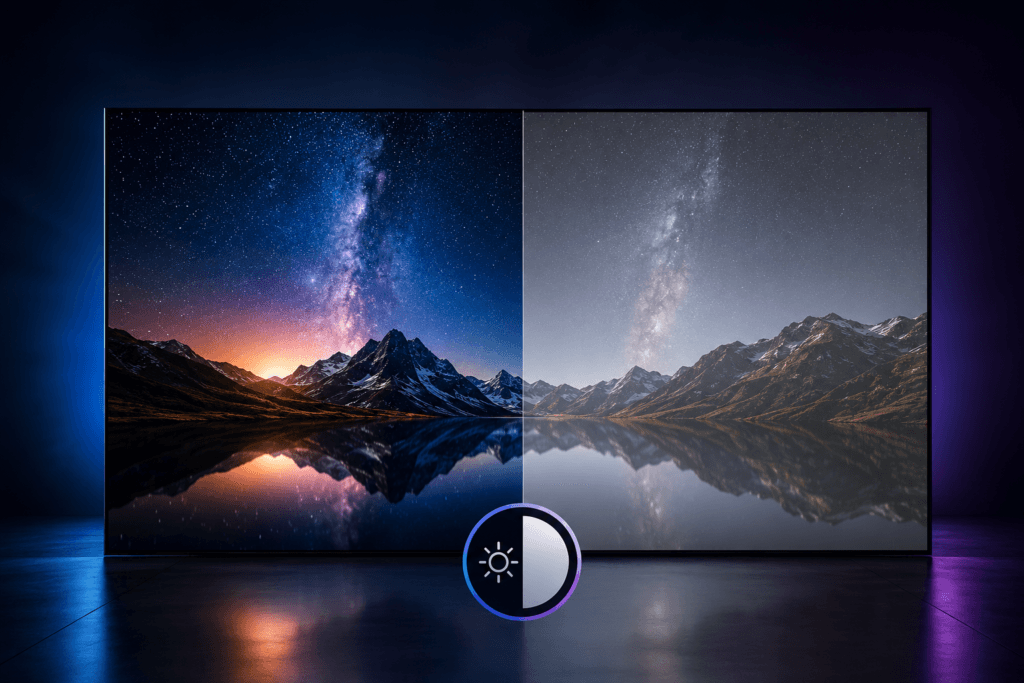
A properly designed high-contrast LED display can make advertisements more striking, videos more immersive, and important messages easier to distinguish. In contrast, a low-contrast LED display can make blacks appear washed out, reduce detail in darker areas, and cause text, colors, and images to look flatter or less defined. For buyers, understanding contrast ratio can help ensure the screen performs as expected in its actual viewing environment.
Read this guide to understand LED screen contrast ratio, what affects it, and why it matters for overall screen performance.
| Key Takeaways:
|
What Is LED Display Contrast Ratio?
Contrast ratio is the mathematical relationship between the brightest white a screen can output and the darkest black it can produce at the same time. The bigger the gap between those two extremes, the higher the LED screen contrast ratio and the more depth, detail, and realism the image has.
In practical terms:
- High contrast ratio → deep blacks, punchy whites, sharp detail, images that “pop”
- Low contrast ratio → washed-out blacks, grayish shadows, flat-looking video and text
Unlike LCD or projector screens, which rely on a backlight shining through liquid crystal, an LED display is self-emissive, meaning every pixel is its own light source and can turn fully off. That’s part of why LED technology is capable of such high contrast ratios compared to projector-based displays, which often look fuzzy or blurry due to weaker contrast performance. The screen contrast ratio is typically presented as a ratio, for example, 1000:1 or 3000:1. This number indicates how many times brighter the brightest white is than the darkest black.
| If an LED display produces 5,000 cd/m² of white luminance and 1 cd/m² of black luminance, its theoretical contrast ratio would be 5,000:1. This means the white part is 5,000 times brighter than the black part. Higher numbers mean clearer images and deeper dark colors. |
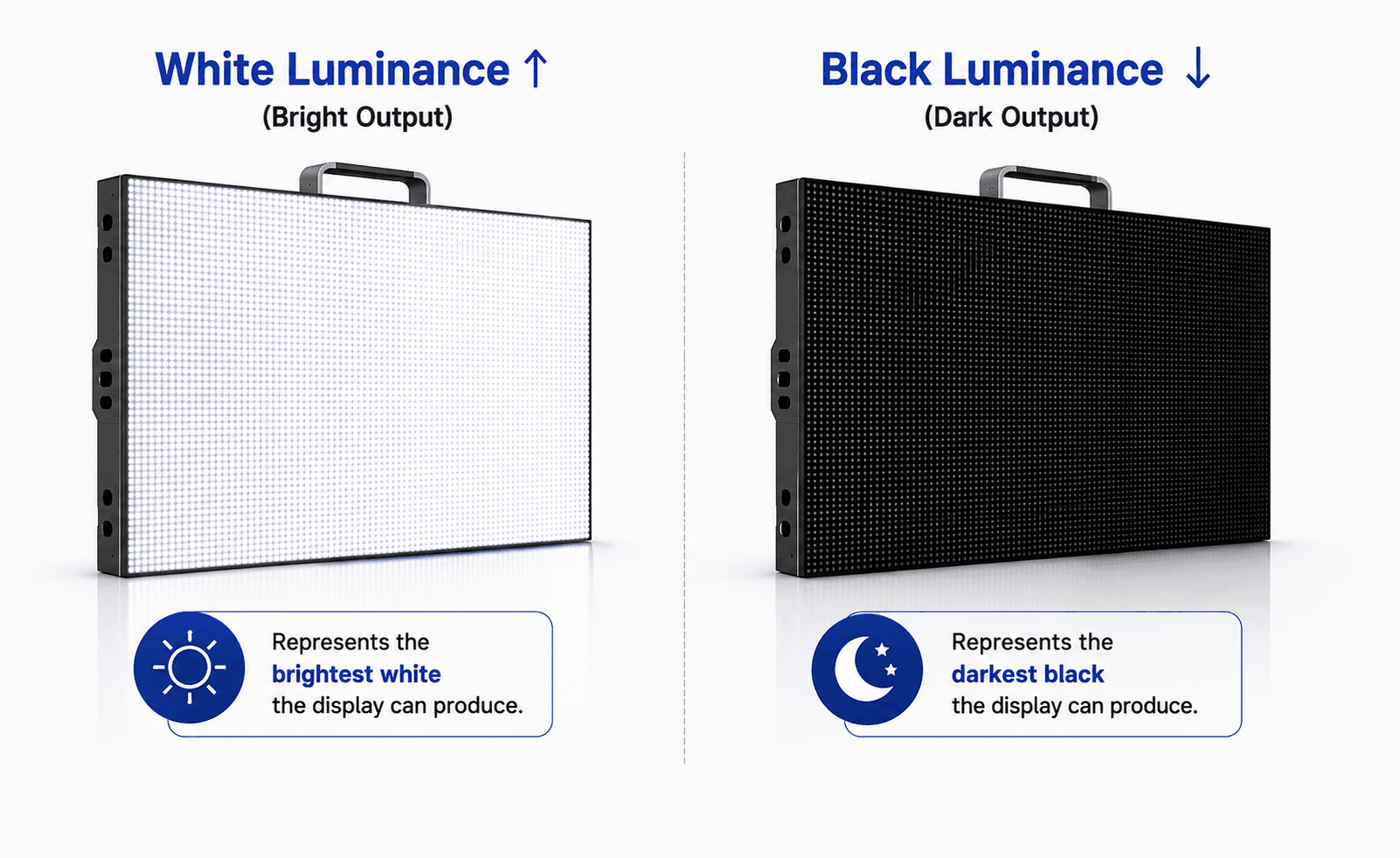
| The basic formula is: Contrast Ratio = White Luminance ÷ Black Luminance |
In simple terms, a higher contrast ratio means there is a larger visual difference between bright and dark areas. That difference affects:
- Black depth
- Color richness
- Shadow detail
- Image depth
- Text clarity
- Video quality
- Overall visual impact
A higher contrast ratio helps separate dark and bright areas, making videos, advertisements, and live content appear sharper and more visible. This is especially important for stadium displays, where content must remain clear from different viewing angles and distances. Dreamway’s stadium perimeter LED display and outdoor LED displays are designed for outdoor environments, with high brightness and wide viewing angles to support strong visibility. However, the number on a specification sheet does not tell the entire story. Contrast measurements can vary depending on measurement methods and operating conditions.
| QUICK INFO: Indoor LED displays commonly start around 3,000:1 contrast, while premium models can reach 5,000:1 or higher for deeper blacks and clearer separation between dark and bright areas. |
Static vs. Dynamic vs. Ambient Contrast Ratio
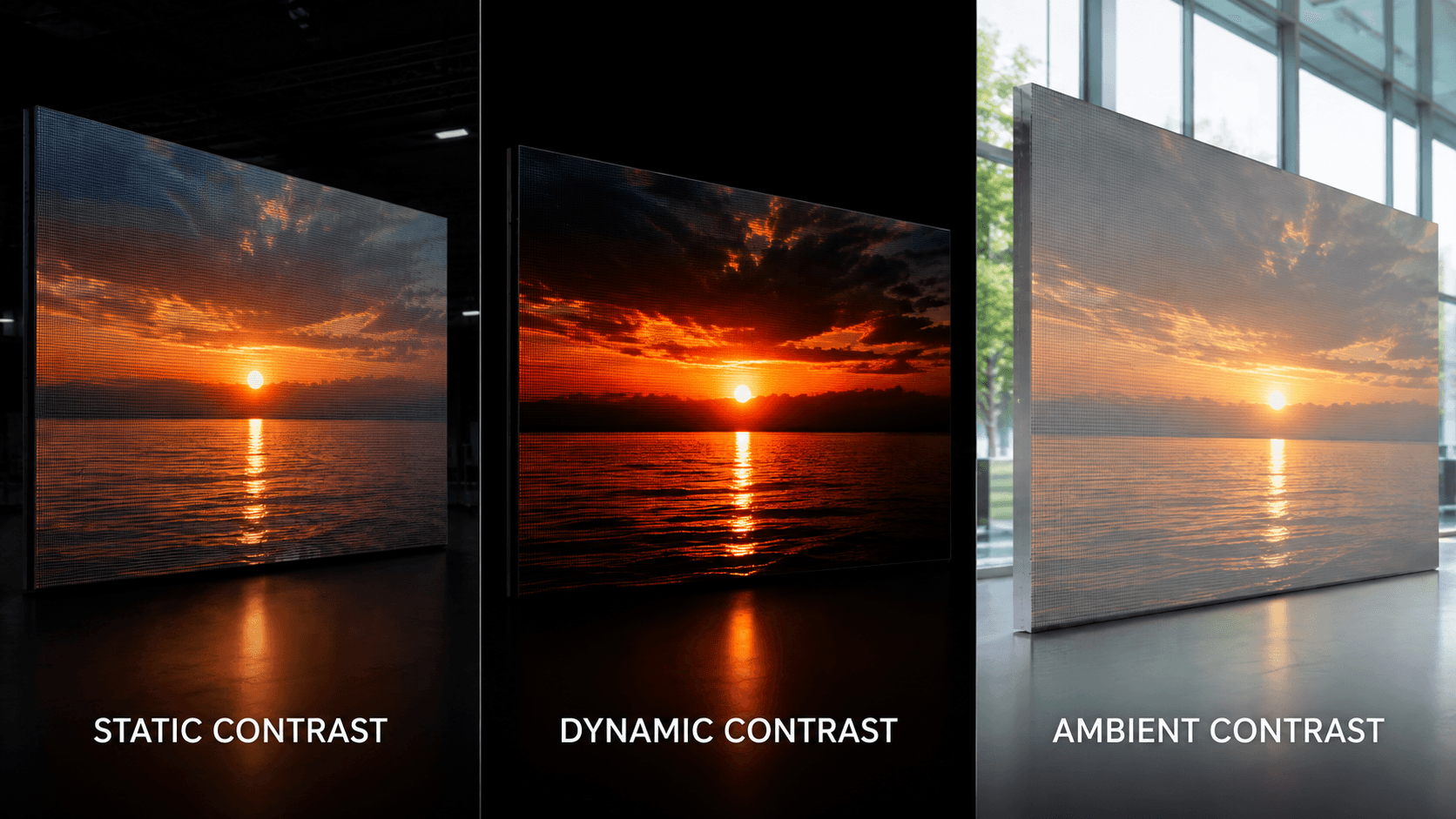
When comparing an LED screen’s contrast ratio, pay attention to whether the manufacturer provides a static or dynamic figure.
| Type | What It Measures | Why It Matters |
| Static contrast | Bright and dark performance under a defined condition | More useful for comparing displays |
| Dynamic contrast | Contrast achieved by changing display output between scenes | Can produce much larger numbers |
| Ambient contrast | Contrast while environmental light is present | More representative of real-world viewing |
For most LED display purchasing decisions, the conditions under which the measurement is taken are just as important as the number itself.
Why LED Display Contrast Ratio Matters for Screen Performance
A high-quality LED display is not judged by resolution or brightness alone. The LED display contrast ratio determines how effectively a screen separates its darkest and brightest areas, which directly influences how viewers perceive detail, color, depth, and clarity.
1. Shadow Detail & Clarity
Contrast ratio plays an important role in how effectively an LED display reproduces dark scenes and subtle details. When the difference between the screen’s darkest and brightest areas is limited, dark portions of an image can blend together. Instead of seeing individual objects, textures, or background elements, viewers may see one large area of gray or black.
A LED display with stronger contrast can maintain greater separation within these darker portions. For example, in a movie scene showing a person in a dimly lit room, higher contrast can help preserve details in clothing, walls, furniture, and facial features without making the entire scene appear gray.
Here is a quick catch of what better contrast ratio can help preserve:
- Details within dark scenes
- Separation between nearby shadow tones
- Textures and objects in darker areas
- Depth in photographs and videos
This is especially valuable for video walls, advertising displays, broadcast screens, and entertainment applications, where maintaining detail throughout an image is important.
2. Perceived Sharpness
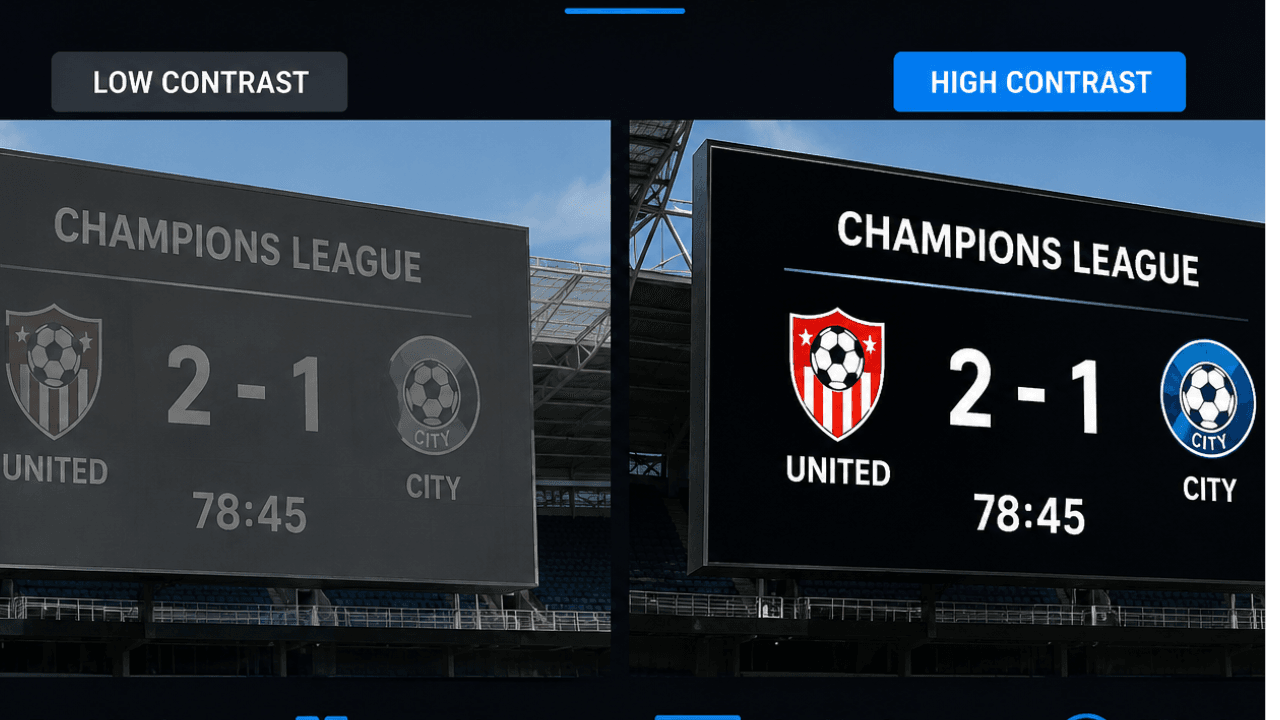
Learning how to choose LED display resolution and pixel pitch is important because resolution indicates how much physical detail a display can reproduce, while contrast ratio determines how clearly the eye can distinguish that detail. When a dark object appears against a bright background, the greater difference between them creates a more defined edge.
This matters for almost everything displayed on an LED screen, including:
- Text and numbers: Letters appear more defined and easier to read.
- Logos and icons: Strong contrast helps shapes stand out from the background.
- Graphics and images: Clear separation between light and dark areas makes details easier to recognize.
- Video content: Objects and subjects appear more visually distinct, particularly in scenes with dark and bright elements.
For example, white text on a deep black background generally appears sharper than the same text placed against a lighter gray background. The higher contrast makes the boundaries around each letter easier for the eye to identify.
| IMPORTANT NOTE: A higher contrast ratio does not increase the display’s actual resolution or create additional pixels. Instead, it improves perceived sharpness by making existing details and edges easier to distinguish. |
This becomes particularly important for large-format LED signage, where viewers may be standing several feet or even hundreds of feet away from the screen. When contrast is properly balanced with pixel pitch and viewing distance, content can remain clear and visually impactful even from a distance.
3. Color Vibrancy
Contrast plays an important role in how viewers perceive the richness, depth, and intensity of colors on an LED display. When bright colors appear against deep blacks or clearly defined dark backgrounds, they tend to stand out more strongly.
For example, imagine a digital advertisement featuring bright red, blue, or green graphics on a black background. When the display can produce deep blacks, the colors have a stronger visual separation from the background, making the overall content appear more vibrant and engaging.
Good LED display contrast can help:
- Bright colors stand out more clearly against dark backgrounds.
- Brand colors appear more impactful, making advertisements easier to notice.
- Images look deeper and more dimensional rather than flat.
- Dark backgrounds remain clean and defined instead of appearing gray or washed out.
- Visual content becomes more engaging, particularly in advertising and entertainment applications.
However, contrast ratio should not be confused with color gamut or color accuracy. A high contrast ratio does not automatically mean that an LED display can reproduce more colors or reproduce them accurately. These are separate display characteristics that work together to determine overall image quality. For applications such as retail advertising, concerts, sports venues, and branded digital signage, this combination can make visual content appear more engaging.
4. Ambient Light Resistance
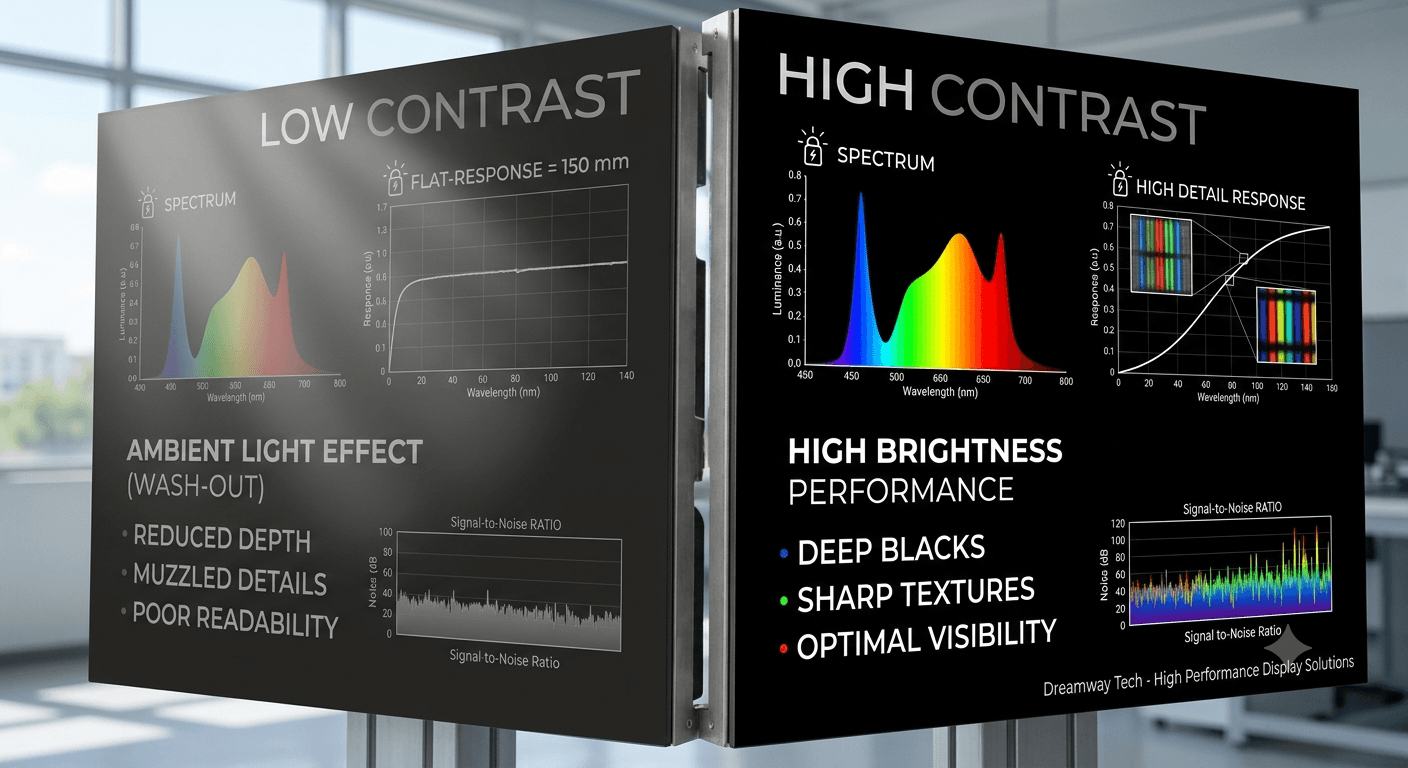
Ambient light is one of the biggest challenges for LED displays, particularly those installed outdoors. Sunlight, nearby lighting, and reflections can make dark areas of a screen appear brighter than they would in a controlled environment. This reduces the effective contrast that viewers perceive. A black area that looks properly dark indoors may appear gray when direct sunlight falls on the display. An LED display with a high contrast ratio can provide greater separation between bright and dark content, helping preserve image visibility under challenging lighting conditions.
Here is a quick glimpse of how an LED screen mask affects contrast:
| Standard/white mask: ☀️ → reflected light → gray blacks → washed-out imageBlack LED mask: ☀️ → reduced reflection → deeper blacks → stronger image |
Let’s discuss how this plays out in practice. One of our clients, an Italian motorsport safety solutions provider, needed a display that could remain clearly readable in trackside sunlight and glare, a setting where standard brightness levels wash out quickly. The spec called for 10,000 nits; we delivered a P8 display exceeding that, with one batch reaching 11,400 nits while maintaining current draw at or below that of a standard-brightness P8 panel. That combination — pushing brightness well past typical outdoor levels without a proportional jump in power draw or LED stress is exactly what’s needed to keep contrast intact when ambient light is working against the screen.
5. Viewing Comfort
Contrast ratio can also influence how comfortably viewers read text and view images, particularly when content needs to remain visible for extended periods. When text and graphics are clearly separated from their backgrounds, viewers can distinguish them more easily. For example, dark text on a sufficiently light background or bright text against a dark background provides a clear visual boundary between the characters and their surroundings.
Poor contrast can make viewers work harder to distinguish subtle differences, especially when the screen is viewed from a distance or under difficult lighting. This can make signage feel less comfortable to read. That said, contrast ratio should not be presented as a standalone measure of eye comfort. Brightness level, viewing distance, ambient lighting, refresh rate, flicker characteristics, font size, and content design can all influence visual comfort. The most comfortable LED display is one where these factors are properly balanced.
So, What Is a Good Contrast Ratio?
There’s no single number that counts as “good” as it depends on where and how the screen is used. As a general benchmark:
| Application | Typical Good Contrast Ratio | Notes |
| Indoor advertising / retail displays | 3,000:1 – 5,000:1 | Controlled lighting, closer viewing |
| Control rooms / broadcast studios | 4,000:1 – 6,000:1 | Color accuracy and detail are critical |
| Semi-outdoor screens (covered areas) | 5,000:1 – 8,000:1 | Some ambient light exposure |
| High contrast ratio outdoor LED screen | 8,000:1 – 10,000:1+ | Direct sunlight, needs deep blacks and high brightness together |
| Cinema-grade LED walls | 10,000:1 and above | Near-projector or better black levels |
As a rule of thumb, anything above roughly 5,000:1 is considered strong for most commercial applications, and figures at or above 10,000:1 are what manufacturers highlight for premium or cinema-grade panels. What matters more than the raw number is whether the contrast holds up under the screen’s actual operating conditions; a 5,000:1 rating measured in a dark lab means little if the panel loses most of that contrast the moment it’s placed under sunlight or bright store lighting.
| Looking for a reliable LED screen manufacturer and supplier? Choose Dreamway! With 10+ years of experience, service in 80+ countries, and 24/7 technical support, we provide indoor and outdoor LED display solutions designed to deliver strong visual performance and reliable operation at competitive wholesale pricing. Want to see our work in action? Explore Dreamway’s LED display projects and case studies to see the solutions we have delivered for different applications and industries. |
Conclusion
LED display contrast ratio is more than a number on a product specification sheet. It affects how viewers perceive blacks, colors, details, text, and overall image depth. For indoor applications, contrast can determine whether an LED wall delivers a cinematic, premium appearance or a flatter image.
For outdoor applications, the challenge becomes even greater because sunlight and other ambient illumination can reflect from the display and reduce effective contrast. That’s why the best approach is to evaluate contrast, brightness, LED package, mask, surface treatment, pixel pitch, and installation conditions together.
FAQs
1. What is the LED display contrast ratio?
LED display contrast ratio measures the difference between the brightest white and darkest black a display can produce. A higher ratio generally allows for deeper blacks and clearer separation between bright and dark areas.
2. What is a good contrast ratio for an LED display?
There is no single ideal number because the right contrast ratio depends on the application and viewing environment. However, for a standard indoor LED display, a good contrast ratio is 3,000:1 to 5,000:1. This range provides deep blacks, clear shadow details, and vivid colors for commercial uses, control rooms, or home setups. For basic indoor tasks, 1,000:1 is acceptable, while high-end or fine-pitch screens aim for 5,000:1 or higher.
3. How does ambient light affect LED screen contrast?
Ambient light lowers LED screen contrast by reflecting off the glass, turning true blacks into hazy grays. This cuts the visible gap between dark and bright parts, washing out the image and reducing the effective ambient contrast ratio.
4. How can LED screen contrast be improved?
To improve LED screen contrast, optimize hardware and software settings by lowering room ambient light, increasing peak brightness or local dimming, reducing surface reflectivity, and calibrating display settings (setting contrast to 90–100% and lowering black levels)
5. What is the difference between static and dynamic contrast ratio?
Static contrast measures the difference between bright and dark output under a defined condition, while dynamic contrast can involve changing display output between scenes. Static contrast is generally more useful when comparing display specifications.
6. Does a higher contrast ratio make an LED display brighter?
Not necessarily. Contrast and brightness are different specifications. However, deeper blacks can make bright elements appear more prominent because the visual difference between dark and bright areas is greater.
7. Why is contrast ratio important for outdoor LED screens?
Outdoor screens are exposed to sunlight and other ambient light, which can raise apparent black levels and wash out images. Strong contrast, combined with sufficient brightness and suitable mask and surface design, can help maintain image visibility.
8. Does contrast ratio affect LED display color quality?
Yes, contrast can influence how viewers perceive color depth and vibrancy. However, contrast ratio does not determine color accuracy or gamut by itself; those are separate display characteristics.
9. Is a 10,000:1 contrast ratio better for every LED display?
Not automatically. A higher specification can be beneficial, but the measurement conditions and actual installation environment matter. Brightness, ambient light, LED package, mask, and surface treatment should also be evaluated.
10. Does contrast ratio affect LED screen readability?
Yes. Strong separation between text and its background can make letters, numbers, and graphics easier to distinguish, particularly when the screen is viewed from a distance or in challenging lighting conditions.