Table of Contents
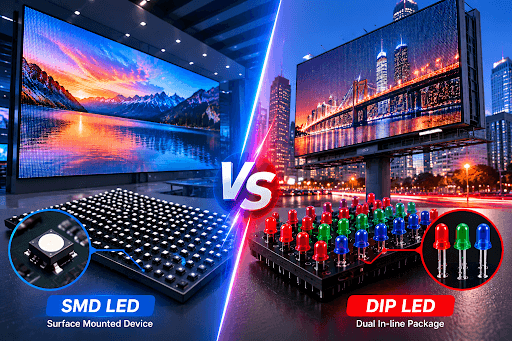
When procurement managers and AV integrators start speccing out an LED display project, the question of SMD vs DIP LED technology comes up early and often. Both are widely used, and appear in supplier catalogs with similar-looking photos. The difference is in how they actually perform once installed.
The choice between SMD LED display and DIP LED display technology affects screen brightness under sunlight, image sharpness at different viewing distances, how long the system lasts outdoors, and what power and maintenance costs look like over time.
This guide covers the real differences, where each technology wins, and how to match the right one to your project.
What Is the Difference Between SMD and DIP?
The difference starts at the packaging level, which is how the red, green, and blue LED chips are assembled onto the printed circuit board (PCB) inside each display module.
What Is DIP LED Technology?
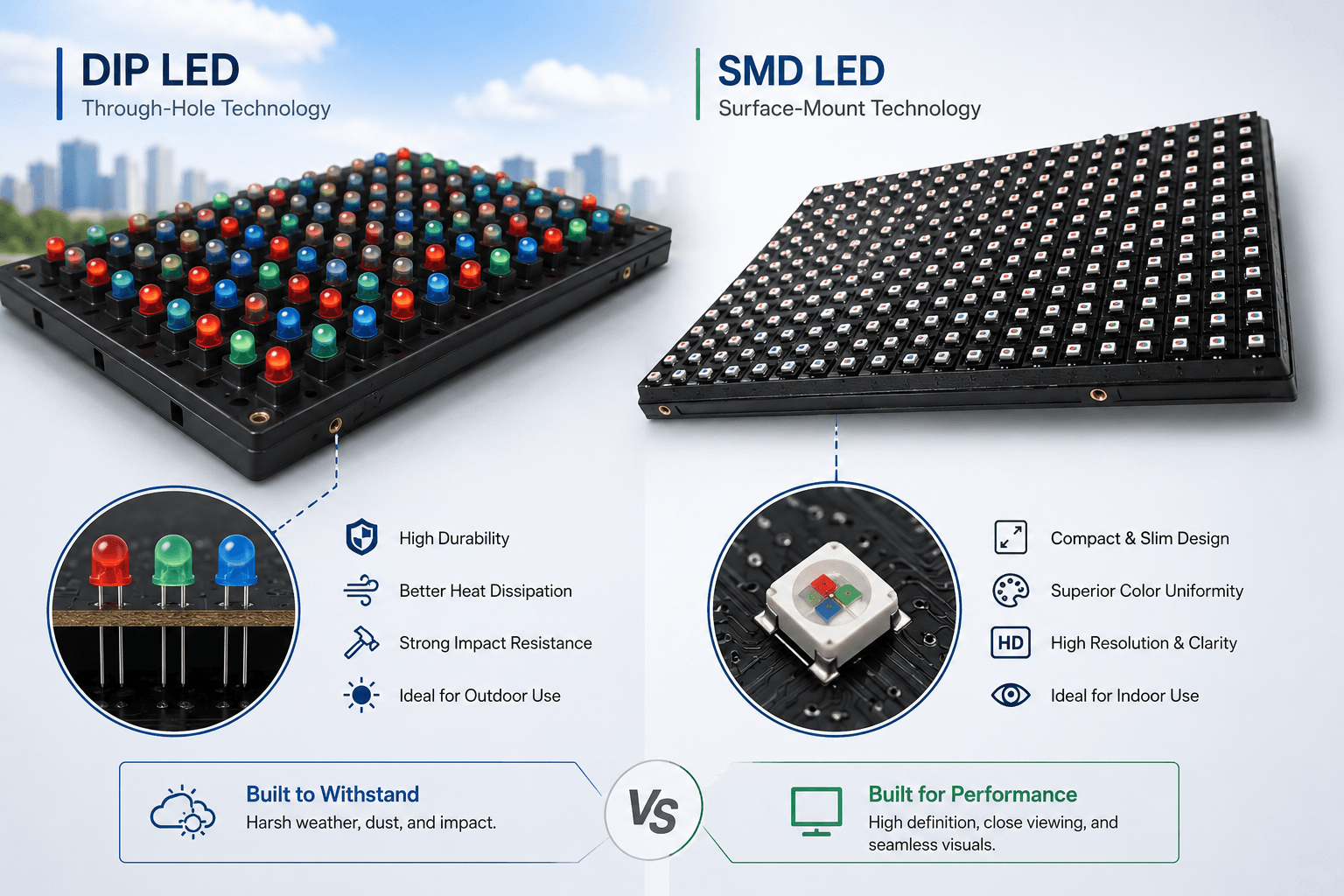
DIP stands for Dual In-line Package. It is the oldest form of LED packaging still in active commercial use. In a DIP LED display, each pixel consists of three separate bulb-shaped LEDs, one red, one green, and one blue, mounted through drilled holes in the PCB with two long metal pins each.
Those pins extend below the board and provide a physical anchor. That through-hole mounting is what gives DIP its durability advantage. The components sit further apart, ventilate better, and resist impact and vibration more than surface-mounted alternatives.
What Is SMD LED Technology?
SMD stands for Surface Mounted Device. In an SMD LED display, all three RGB chips are combined into a single compact package and mounted directly onto the surface of the PCB. The result is a much smaller, flatter pixel.
Because all three colors share one housing, color blending happens at the bead level. That is why SMD LED technology produces smoother gradients and sharper images than DIP, particularly at close viewing distances.
SMD vs DIP LED Display: Head-to-Head Comparison
| Feature | SMD LED Display | DIP LED Display |
| Pixel structure | RGB chips in one package | Separate R, G, B bulbs |
| Brightness | 4,500–8,000 nits (outdoor) | 7,500–10,000+ nits |
| Viewing angle | 140–160° horizontal & vertical | 100–120° horizontal, ~60° vertical |
| Pixel pitch range | P0.9 to P10+ | P8 to P25+ |
| Resolution | High (fine pitch capable) | Lower (larger pixel gap) |
| Durability | Good; improved with GOB coating | Excellent; through-hole strength |
| Weather resistance | Good (IP65 with proper enclosure) | Very high (thick encapsulation) |
| Lifespan | 50,000–80,000 hours | Up to 100,000 hours |
| Weight | Lighter | Heavier |
| Power efficiency | ~30% more efficient than DIP | Higher power draw per sqm |
| Best application | Indoor and semi-outdoor | Large outdoor billboards |
Brightness: Where DIP Still Has the Edge
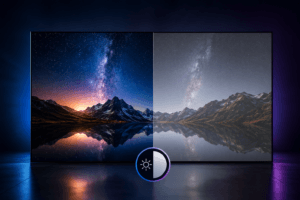
Raw brightness is the one area where DIP LED displays remain ahead. A standard DIP outdoor display produces between 7,500 and 10,000 nits, which holds up under direct sunlight on a highway billboard.
An SMD outdoor LED display typically peaks at 4,500 to 8,000 nits depending on the module grade. That is adequate for most environments, but in high-ambient-light situations, particularly large rooftop or highway-facing screens, the DIP brightness advantage is real.
For indoor video walls, retail displays, broadcast studios, and control rooms, SMD LED technology delivers sufficient brightness for the application while drawing less power.
Which Provides Better Viewing Angles?
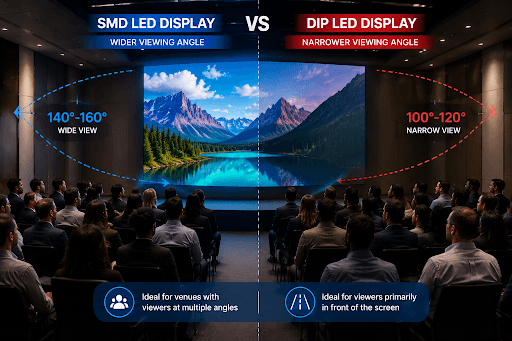
This is where SMD LED displays pull clearly ahead. Because all three color chips sit inside one compact housing, light radiates outward more evenly in all directions.
SMD viewing angles typically reach 140 to 160 degrees horizontally and vertically. DIP LED technology delivers roughly 100 to 120 degrees horizontal and around 60 degrees vertical.
A conference room, retail space, airport, or stadium concourse where viewers stand at varied positions across a wide arc needs SMD LED technology. A highway billboard where the viewing position is roughly forward-facing can work well with DIP.
For large-format outdoor advertising applications, Dreamway’s advertising LED screen solutions cover both technologies across a range of pixel pitches, with specification support included.
Which Lasts Longer Outdoors?
For outdoor longevity, DIP LED displays carry a structural advantage. The through-hole mounting anchors each component more securely in the PCB, making them resistant to vibration, impact, and temperature swings. The wider spacing between components also supports better natural heat dissipation.
DIP LEDs are rated for up to 100,000 hours. SMD LED displays typically reach 50,000 to 80,000 hours, which is still a strong commercial lifespan, but the gap between the two is documented across the industry.
Modern outdoor SMD LED screens with GOB (Glue-on-Board) protective coating and IP65-rated enclosures have closed that gap meaningfully. A properly specified outdoor SMD system handles harsh climates far better than older uncoated panels, though DIP still holds the durability edge in the most demanding environments.
Pixel Pitch and Resolution
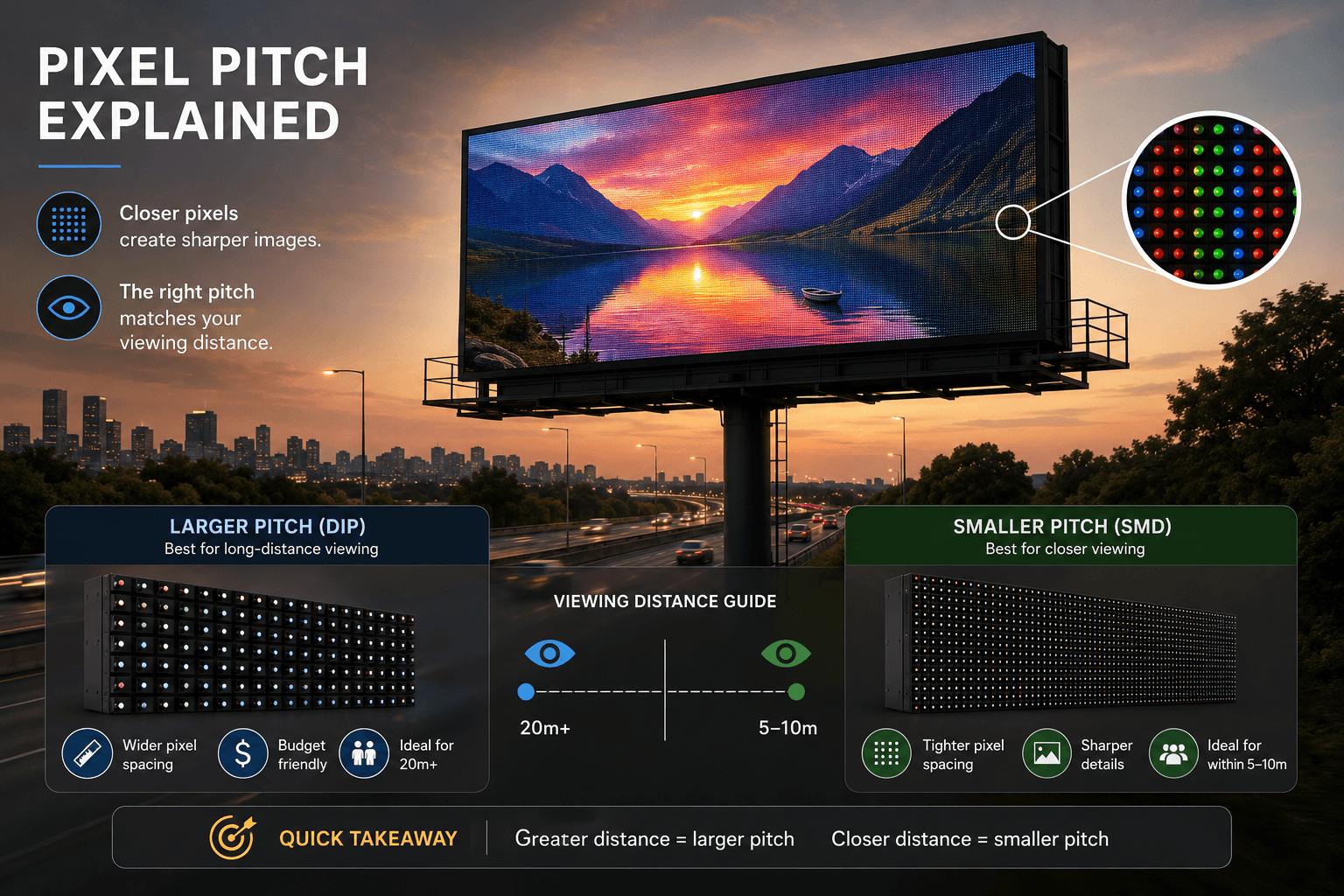
Pixel pitch is the distance in millimetres between the center of one pixel and the next. Smaller pitch means more pixels per square meter, which produces a sharper image at closer viewing distances.
SMD LED technology is the only viable choice below P5. The compact packaging allows pitches as fine as P0.9. A DIP LED display physically cannot reach fine pitches because the individual bulbs are too large, which limits DIP to P8 and above.
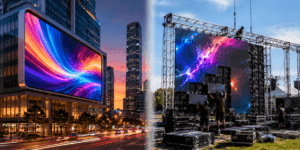
DIP vs SMD for outdoor billboard use is largely a pitch and viewing distance question. For P10 and above on large-format screens viewed from 20 meters or more, DIP is cost-effective. For any installation where viewers are within 5 to 10 meters, SMD is the option that produces a clean image.
If you’re working through the pitch calculation for your installation, Dreamway’s guide on how to choose LED display resolution walks through minimum viewing distance, total pixel count, and content type in one place.
Cost: Which Is More Economical?
At P10 and above for large outdoor screens, DIP LED displays are cheaper per square meter. The technology is mature, manufacturing is optimized, and raw material costs are lower. The price gap versus SMD at the same pixel pitch is meaningful on large-format projects.
For SMD LED displays, cost scales with resolution. A P4 outdoor SMD panel sits at a moderate price point. A P1.5 fine-pitch indoor wall is at the premium end. The cost curve is non-linear, so finer pitches carry a significant price increase per square meter.
SMD LED screens are lighter and consume less power than equivalent DIP setups. On large installations running extended hours, those savings accumulate and factor into the total cost of ownership over the operational lifespan of the system.
Which Technology Is Right for Your Project?
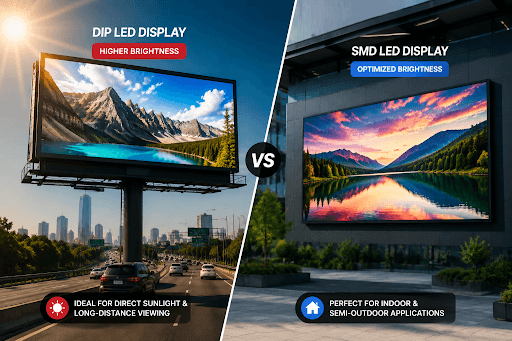
The answer comes down to where the screen lives, how far away viewers are, and what the content demands.
Dreamway’s outdoor LED screens are available in both configurations, with IP65-rated enclosures and GOB coating options, depending on the installation environment.
Choose DIP LED Display If:
- Your screen is a large-format outdoor billboard on a highway, building facade, or sports venue perimeter, viewed from 15 meters or beyond.
- Raw brightness above 8,000 nits is a firm requirement due to direct sun exposure for most of the operating day.
- Your pixel pitch is P10 or above and resolution is secondary to visibility at long distance.
- Budget is a primary constraint on a large outdoor installation and DIP offers the most cost-effective path at the required pitch.
Choose SMD LED Display If:
- Your application is indoor: conference rooms, broadcast studios, retail walls, airports, control rooms, or any space where viewers are within 10 meters.
- You need wide viewing angles of 140 degrees or more because audiences are spread across different positions relative to the screen.
- Your project requires fine pixel pitch below P5 for high-resolution content.
- You are building a rental LED display screen fleet where lighter panels and modular serviceability matter for operational efficiency.
- Your outdoor installation is semi-outdoor or shaded and does not require the peak brightness that DIP delivers.
Dreamway’s rental LED screen range is built around die-cast aluminium cabinets, fast-lock connections, and GOB corner protection specifically for fleet and touring applications.
For a fuller breakdown of when rental versus fixed installation makes the right call, the fixed vs. rental LED display guide covers the decision in detail.
How Dreamway Approaches SMD and DIP Selection
At Dreamway, the technology decision is made at the system level. As a custom LED display manufacturer and system integrator, we source top-tier LED modules from specialist manufacturers and pair them with premium power units and Novastar control systems based on each project’s specific requirements.
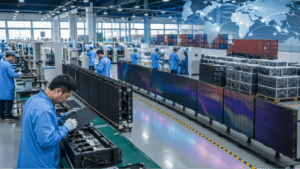
Every system goes through a 72-hour full-screen aging test before it ships. Dead pixels, driver IC inconsistencies, and power supply defects are identified and resolved before the system leaves our facility. The brief we receive from the client determines whether an SMD LED screen or a DIP configuration is the right fit, and the integration and testing process is the same either way.
If you want a technology recommendation based on your specific project parameters, get in touch and the team will turn around a specification within 12 hours.
FAQs
What is the difference between SMD and DIP LED display?
In a DIP LED display, each pixel uses three separate R, G, B bulbs through-hole mounted on the PCB. In an SMD LED display, all three chips sit inside one compact surface-mounted package. SMD is flatter, lighter, and suited to high resolution and wide viewing angles. DIP is brighter and more durable in harsh outdoor conditions.
Which is better for outdoor billboards, SMD or DIP?
DIP vs SMD for outdoor billboard use depends on viewing distance and brightness requirement. For large highway or stadium displays at P10 and above viewed from 15 meters or more, DIP holds an advantage in brightness and cost. For semi-outdoor or high-resolution outdoor displays viewed from closer range, a properly specified SMD outdoor LED display is the more suitable choice.
Which lasts longer outdoors, SMD or DIP?
DIP LEDs are rated up to 100,000 hours and resist impact, vibration, and weather well due to through-hole construction. SMD LED screens rated at 50,000 to 80,000 hours can perform well outdoors when built with GOB coating and IP65-rated enclosures, though DIP holds the edge in the most demanding installations.
What viewing angle does SMD LED technology provide?
SMD LED technology typically provides 140 to 160 degrees horizontal and vertical. DIP LED displays deliver around 100 to 120 degrees horizontal and 60 degrees vertical, which works for long-distance forward-facing billboard viewing but limits visibility for off-angle audiences.
Is SMD or DIP more energy efficient?
SMD LED displays consume less power than DIP at equivalent brightness levels. On large installations running extended daily hours, that difference in power draw is a meaningful factor in operating cost.
Can SMD be used for outdoor LED displays?
Yes. Modern SMD outdoor LED displays with weatherproof encapsulation, conformal-coated PCBs, and IP65-rated cabinets perform well in most outdoor conditions. They are not the preferred option for direct-sunlight highway billboards where peak DIP brightness is required, but for semi-outdoor, covered, or shaded installations they are fully viable.